
Men and Meaning
Trump, precarious masculinity, and the success of gays

In my liberal bubble, we couldn’t comprehend how Trump won in 2016. He was obtuse, crass, and mendacious. But hiding in plain sight were sentiments of alienation and resentment of men across the country who saw him as some kind of answer for their troubles. Though many industries bounced back after the 2008 recession, some traditionally male-dominated areas, like manufacturing, continued to decline, leaving many working-class men feeling economically insecure and forgotten.
Since 2016, things have not gotten better for men. There’s a sharp increase in young men who are unemployed, and fewer men are pursuing higher education, limiting their job prospects in an increasingly knowledge-based economy. More men ages 18 to 34 are also now living with their parents in part because of stagnant wages and high housing costs. These factors have contributed to widespread frustrations, feelings of failure, and isolation.
But instead of effectively responding to these frustrations, the Democrat party has repelled this demographic. Since the spring of 2020, the share of young men registered as Democrats has dropped by seven percentage points, while those registered as Republicans have increased by seven points.1 Amongst Black and Hispanic voters, the gains for the Republican party have been particularly notable.
Richard Reeves, author of Of Boys and Men and president of the American Institute for Boys and Men, posits that; "Democrats got used to speaking about men as the problem, not as people with problems. But of course men do have problems, and problems become grievances when you ignore them."
Democrat Senator Ruben Gallego, who won in Arizona despite Trump carrying the state, recognized this disconnect. "During my campaign, I noticed when talking to men, especially Latino men, about the feeling of pride, bringing money home, supporting your family, bringing security—they wanted to hear that someone understood that need."2 He acknowledges that Democrats' abstract messaging about saving democracy and preventing authoritarianism failed to connect with these voters' lived experiences.
Instead, Republicans successfully connected with their male base by crafting a dual message of economic opportunity and cultural restoration. Trump's campaign promised to revitalize American manufacturing, implement protective tariffs, and restrict immigration that they claimed threatened domestic jobs. This was paired alongside a narrative of returning to traditional “American values" and resonated with men feeling culturally alienated.
They brought their messaging directly to young men, targeting them where they were. During Trump’s campaign, he went to UFC fights and flaunted endorsements from figures like Jake Paul, Hulk Hogan, and various rappers. He also did the ultimate “manly” thing and appeared on Joe Rogan’s podcast.
Until very recently, I didn’t really understand the significance of this. It’s just a podcast, right?
But I was wrong. As Devin Gordon in the Atlantic puts it, “Few men in America are as popular among American men as Joe Rogan. It’s a massive group congregating in plain sight, and it’s made up of people you know from high school, guys who work three cubicles down, who are still paying off student loans, who spot you at the gym. Single guys. Married guys. White guys, black guys, Dominican guys. Two South Asian friends of mine swear by him. My college roommate. My little brother. Normal guys. American guys.”3
Gordon explains that Rogan appeals to men as a mentor figure. Through his podcast, Rogan encourages them to succeed, search for purpose, develop self-respect, and pursue self-improvement.4
What especially distinguishes Rogan is his genuine connection with what Gordon calls a "middle-bro audience…men with barbed-wire tattoos who stock their fridges with Monster energy drinks.” Rogan embraces these men without the "condescension and ironic distance" that typically characterizes how liberal elites engage with middle-class men. This point is especially salient considering that Kamala Harris’s campaign team went back and forth on whether to appear on Rogan’s show, but she ultimately didn’t. So Trump not only got unrivaled access but also an endorsement from Rogan, reaffirming his electoral support from men.
The common thread connecting Joe Rogan and other popular male influencers like Jordan Peterson is their ability to resonate with men and boys seeking direction. They've built loyal followings by acknowledging men's concerns while offering pathways towards self-improvement. However, this pull toward online mentoring also leads to con artists like Andrew Tate, who take advantage of male insecurity to promote misogyny.
This period in American history presents a complex landscape for male identity. Traditional sources of masculine self-worth, like physical labor, are irrelevant. Many men find themselves without compelling alternative role models or frameworks, leading to questions about their purpose. The popularity of “God-like” podcasters and media personalities, like Rogan, reveals a hunger for guidance and spaces for men to feel their frustrations are taken seriously, rather than dismissed or vilified.
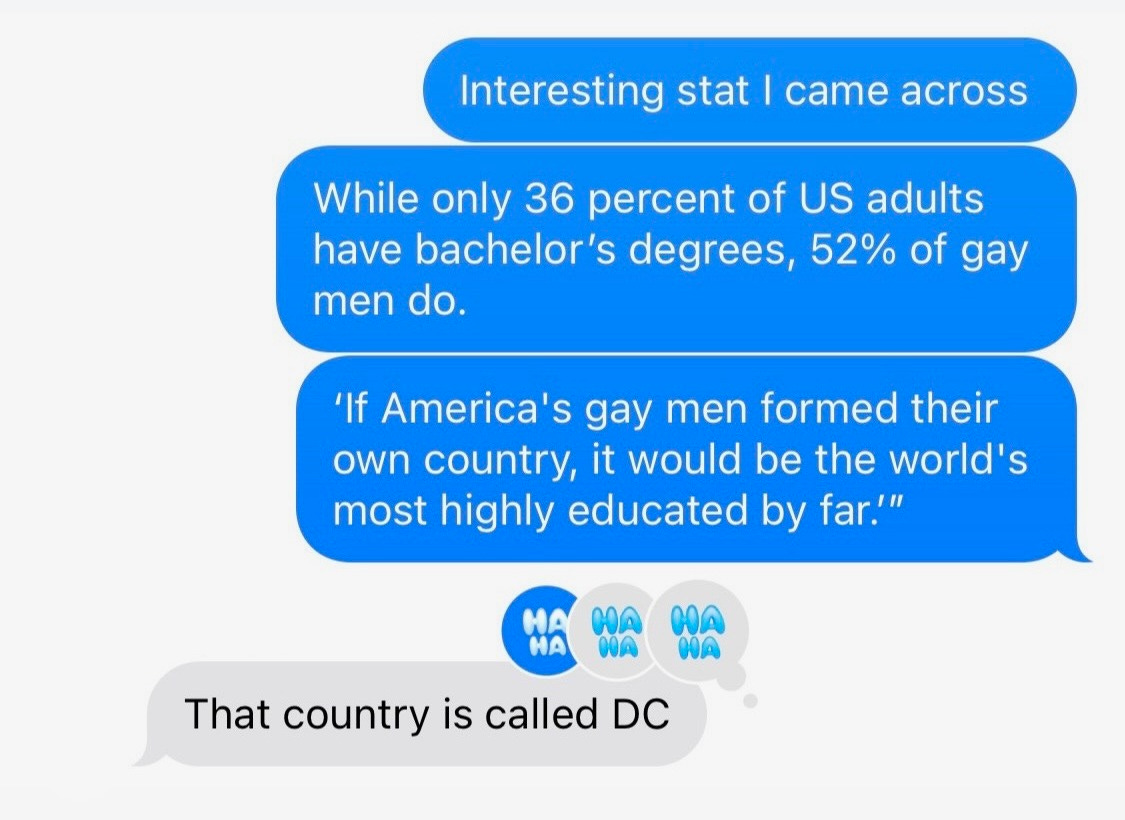
It is important to note that not all men are in crisis mode; one group is notably doing quite well: gay men. While only 36 percent of US adults have bachelor’s degrees, 52% of gay men do.5 Gay men are also about 50 percent more likely to have earned an MD, JD, or PhD than straight men. “If America's gay men formed their own country, it would be the world's most highly educated by far.”
This difference is academic success seen early. Joel Mittleman’s research found that at the same school, gay boys earned higher grades, were in more advanced classes, and had more serious work habits than their straight peers. Gay men have learned to operate outside of traditional and stereotypical masculine expectations, granting them freedom to authentically pursue their goals without conforming to rigid stereotypes.
The struggles faced by men are not rooted in their biological sex, but rather in the pursuit of a form of masculinity contingent on external validation. This inherently precarious approach to manhood compels men to compensatory behaviors when their masculine status feels threatened, including increased aggression, greater risk-taking, and reduced support for gender equality.6 This has severe health implications. A 2023 study revealed that in countries with stronger beliefs in precarious masculinity, men's life expectancy was over six years shorter, and had higher frequencies of risky behavior like drinking and smoking. Further evidence indicates that men's internalized belief of failing to meet societal expectations of manhood, a phenomenon psychologists term “masculine discrepancy stress,” is a significant predictor of violence. Research demonstrates that heightened stress correlates with a greater likelihood of committing various violent acts, including sexual assault.7
Social scientists have also connected the appeal of conservative politics, particularly figures like Trump, to masculine anxiety, or what they term “precarious masculinity.”8 Cross-cultural research reveals that manhood, the social status of being a male adult, is often perceived as a precarious state demanding constant earning and defense.9 This fosters persistent anxiety due to the ever-present threat of losing it. As a result, “Men and boys work overtime to avoid the threat of emasculation, because the social price they pay for it is so high.”10
This anxiety is especially notable in the school setting. Research has shown that being serious about school contradicts with masculinity, while disengagement is seen as an enhancement of masculinity. ”11 Boys don’t want to look too smart and don’t want to look like they’re pleasing the teacher… girls can negotiate the fine line between what peers want of them and excelling at school. Boys have a harder time balancing being socially accepted and academically focused.”
The impacts of this are profound. In the US, 70% of high school valedictorians are women. American women earn roughly three-fifths of all bachelor’s and master’s degrees, and they are the majority of medical and law students.12 Outside the US, girls still outperform boys in advanced countries, even in countries with considerable sexism, such as South Korea, and in egalitarian ones like Sweden.
Reading Reeves's Of Boys and Men pieced together my early observations of the absence of straight men in my academic and extracurricular sphere. In high school, my AP courses and youth groups were notably composed of women and gay men. This trend followed me as an undergrad at Georgetown and was particularly prevalent in my humanities-focused degree, community service involvement, and study abroad stints in Spain and Ecuador.
Feminism has achieved significant gains for the livelihood and well-being of women in America; a parallel effort is now urgent to foster a form of positive masculinity in boys and men.
“What held girls back from succeeding in school were both institutional and structural barriers as well as traditional ideologies of femininity. As women and girls challenged those traditional
ideologies, they successfully challenged those institutional barriers. What holds boys back from succeeding at school is the persistence of those traditional ideologies of masculinity.”
Just as media and civil society have launched countless campaigns to empower young women, similar initiatives are needed to redefine masculinity. This redefinition involves shifting the focus from external expressions like aggression, competition, and dominance to internal values such as generosity, integrity, and empathy.
To cultivate this positive masculinity, boys and young men require support, including close friendships for emotional intimacy, mentors for guidance, and opportunities that provide a sense of purpose and meaning. A critical step in this process is de-stigmatizing emotional vulnerability among males. Boys and men, like all individuals, are inherently social beings whose well-being and even survival depend on meaningful relationships.
Boys are interested in exploring gender, masculinity, and life purpose. However, many lack consistent, positive messaging on these issues from families or schools, creating a void vulnerable to harmful influences.13 This absence of constructive guidance has serious consequences: boys feeling unwanted, socially unfit, and disconnected, become withdrawn. Such cultural alienation breeds profound mistrust, contributing to disengagement and even violence, as experts note: "Mass shooters struggle with mental illness, but that's not why they are violent; many mentally ill individuals never commit violence. Their violence stems from a culture devaluing their full humanity, causing disconnection from themselves and others."14
To counteract this cycle of alienation and its potential for harm, exploring pathways for reconnection and purpose is crucial. One example of this is engaging men in the “care field.” This offers a dual solution: providing meaningful opportunities for young men and creating much-needed male mentors for boys. Some research has argued that the absence of male teachers in primary school is a driving factor of academic disengagement from boys. More than 90% of all elementary school teachers and three-fourths of all U. S. teachers are female.
More men in the care field can also "reconnect [disengaged men] with people in their communities who may be struggling worse than them."15 Encouraging young men to volunteer or intern in growing fields like teaching, nursing, and social work can destigmatize these careers early, fostering community connection and ultimately improving their economic success and well-being.
The perils of straight men is a topic I openly discuss with my best friend from college. He’s a gay man from the Midwest who was a magna cum laude graduate with degrees in math and computer science. He’s now completing a master’s degree at Science Po Paris as a Fulbright scholar. While he is meeting very high markers of societal success, his younger straight brother faced behavior problems throughout high school, dropped out of community college, and is working in home remodeling. He constantly worries about his brother’s future, and his worries are rightfully placed given the fact that Trump’s tariffs and looming recession will disproportionately harm young men without a college education.
Though my friend’s brother has male relatives in his life, he doesn’t seek their guidance. Admitting the need for help from family members can be daunting, so young men may turn to friends and, as noted before, internet personalities for mentoring. While they may get some good pieces of advice, it's often limited by their lived experiences. One fix to this is to promote cross-generational friend groups. In his Substack, Darrell Ownes explains that though he had early beliefs and behavior that could have led him to become a resentful hyper online male, it was real-life friendships and acquaintances with older men that helped him formulate career ambition and bring perspective into his life. “To be friends with older men with the lifestyles and families I wanted had a much greater impact than curated social media feeds of influencers.”16
The challenge is finding spaces where cross-generational friendships can flourish organically in an increasingly disengaged society. While church and recreational leagues used to be the primary vessels for this, the rise in technology and entertainment has made the home an impenetrable retreat. What got Darrell off the internet and into the community was following his interest in the pro-housing movement. Through his gradual involvement in organizing with a local group, he cultivated strong relationships with both older men and women that helped him navigate the early stages of dating, university, and work.
Instead of going through rabbit holes about the Roman Empire on Reddit, young men could be directed to their neighborhoods' historical societies or local museums and harness their curiosity for the community’s benefit. Following interests and hobbies, joining collectives larger than themselves, and being attuned to the community's needs can help connect young men to mentors and bring meaning to their lives. This won’t guarantee a job or relationship, but it can prime men with the soft skills needed to thrive in modern society. Fewer jobs require physical labor, and more insist on communication, problem-solving, and emotional intelligence skills. A masculinity that embraces this, instead of aggression, dominance, and emotional detachment, is needed.
This post was inspired by Celsete Davis’s article “Why aren't we talking about the engine running our world?” and Adam Ruins Everything video, Elon and Zuck are insecure men.
John Della Volpe. “Trump’s Bro Whispering Could Cost Democrats Too Many Young Men.” The New York Times. (Oct 21, 2024)
Garcia-Navarro, Lulu. “ Senator Ruben Gallego on the Democrats’ Problem: ‘We’re Always Afraid’” The New York Times. (Feb 15, 2025)
Devin Gordon. “Why Is Joe Rogan So Popular?” The Atlantic. (Aug 19, 2019)
Faiaz “Why is the “Joe Rogan Experience” so popular among men?” Medium. https://medium.com/blog-faiaz/why-is-the-joe-rogan-experience-so-popular-among-men-42677de464fb (Aug 2019)
Joel Mittleman. “What gay men’s stunning success might teach us about the academic gender gap.” The Washington Post. (Feb 24, 2022)
Vandello, Joseph A., Jennifer K. Bosson, Dov Cohen, Rochelle M. Burnaford, and Jonathan R. Weaver. "Precarious manhood." Journal of personality and social psychology 95, no. 6 (2008): 1325.
Ruth Whippman. “We Can Do Better Than ‘Positive Masculinity.’” The New York Times. (Oct 8, 2024)
Carian, Emily K., and Tagart Cain Sobotka. "Playing the Trump card: Masculinity threat and the US 2016 presidential election." Socius 4 (2018)
Vandello, Joseph A., Jennifer K. Bosson, Dov Cohen, Rochelle M. Burnaford, and Jonathan R. Weaver. "Precarious manhood." Journal of personality and social psychology 95, no. 6 (2008)
Ruth Whippman. “We Can Do Better Than ‘Positive Masculinity.’” The New York Times. (Oct 8, 2024)
Michael Kimmel. “Boys and School: A Background Paper on the “Boy Crisis”” Swedish Government Official Reports. (2010)
Idrees Kahloon. “What’s the Matter With Men.” The New Yorker. (January 23, 2023)
Keren Landman “How to talk to boys so they grow into better men.” Vox.com. (March 12, 2024)
“Niobe Way's New Book on What Teenage Boys Teach Us.” NYU Steinhardt. (September 05, 2024)
Jay Caspian Kang. “What’s the Matter with Young Male Voters?” The New Yorker. (Oct 25, 2024)
Darrell Owens. “How I Beat Male Radicalization.” Substack: The Discourse Lounge. (April 12, 2025)